
Most people imagine cybercrime as hackers breaking into bank systems or phishing victims online. But in reality, the success of most financial fraud depends on something far simpler:
A bank account.
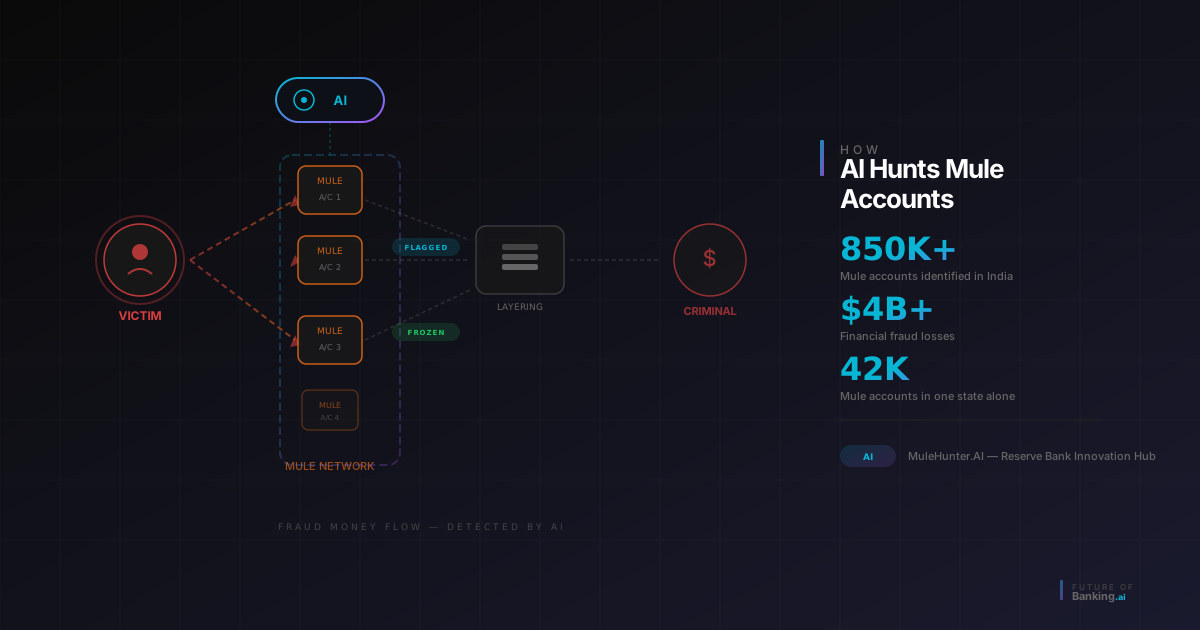
More specifically, mule accounts — ordinary bank accounts used to move stolen money through the financial system.
These accounts are the invisible plumbing of cybercrime. Without them, most digital scams would collapse.
Around the world, regulators and banks are beginning to recognize this weak point in the fraud ecosystem. And increasingly, AI is being deployed to hunt these accounts before criminals can use them.
One of the most interesting examples comes from India, where regulators are experimenting with an AI system designed specifically to detect mule accounts.
But first, to understand why this matters, it helps to understand how big the mule account problem has become.
The Scale of the Mule Account Problem in India
India provides a powerful case study because it has one of the largest digital payment ecosystems in the world.
Platforms like UPI process billions of transactions every month, making digital payments extremely convenient — but also creating opportunities for fraud networks.
Investigations in India show how widespread mule accounts have become:
- The Central Bureau of Investigation identified more than 850,000 mule accounts across over 700 bank branches used in cybercrime operations
- In some cybercrime investigations, tens of thousands of mule accounts have been uncovered in just one region
- Financial fraud losses in the banking system reached over $4 billion in recent years
Cybercrime itself has grown rapidly alongside digital payments. In one state alone, authorities uncovered 42,000 mule accounts linked to cyber fraud networks.
Researchers estimate that cybercrime involving mule networks has led to massive fraud tied to around 40,000 mule accounts within a year.
These accounts are typically created or acquired through several methods:
- Paying individuals to open bank accounts
- Renting accounts from students or low-income workers
- Creating accounts with forged identity documents
- Using legitimate accounts whose owners unknowingly assist criminals
Once a mule account receives stolen funds, the money is quickly transferred across multiple accounts, payment platforms, or even converted into cryptocurrency.
This process — called "layering" — makes it extremely difficult to trace the money back to the original criminals.
In many cases, law enforcement is only able to investigate after the funds have already disappeared.
Why Mule Accounts Are So Dangerous
Mule accounts are not just a local banking issue. They are a global cybercrime infrastructure.
Fraud networks across the world rely on them for scams such as:
- Investment fraud
- Phishing attacks
- Fake job scams
- Romance scams
- Impersonation fraud
- Sextortion schemes
The reason mule accounts are so effective is simple: they allow criminals to launder money through legitimate banking systems while hiding the true beneficiaries.
Traditional anti-fraud systems struggle to detect these networks because they rely heavily on rules and manual monitoring, which are often too slow for modern digital payments.
By the time suspicious activity is detected, the money may already be gone.
India's AI Experiment: Hunting Mule Accounts
To address this growing problem, India's banking ecosystem is experimenting with a new AI-powered system called MuleHunter.AI.
The system was developed by the Reserve Bank Innovation Hub, an initiative linked to the central bank.
Its goal is simple: identify mule accounts before they can be used for fraud.
Instead of relying solely on static rules, the system analyzes massive amounts of transaction data and account behavior.
The AI model studies multiple behavioral patterns associated with mule accounts — including unusual transfer activity, sudden bursts of incoming transactions, and abnormal fund movement.
Early deployments have shown promising results, with banks already detecting thousands of suspicious accounts every month using the system.
In essence, MuleHunter acts like a predator inside the banking system, scanning millions of transactions to identify accounts that behave like money-laundering conduits.
This represents a shift in how fraud detection works. Instead of investigating crimes after they occur, banks can identify suspicious infrastructure before fraud spreads.
Why This Matters Globally
Although the example comes from India, mule accounts are a problem everywhere.
In Europe, the U.K., Australia, and the United States, banks have increasingly warned about "money mule networks" recruiting young people through social media.
In many cases, individuals do not realize they are participating in a criminal operation. They are told they are helping move money for:
- Freelance jobs
- Crypto trading
- Payment processing
- Online gaming platforms
In reality, they are becoming the financial infrastructure for cybercrime.
As digital payments accelerate globally, this problem will only grow.
The Next Phase: Agentic AI in Fraud Prevention
Tools like MuleHunter represent an important step. But the next evolution will likely involve agentic AI systems — autonomous AI agents working together to detect and stop financial crime.
Instead of a single detection engine, banks could deploy entire networks of AI agents monitoring financial activity.
1. Transaction Intelligence Agents
These agents analyze every transaction in real time and flag suspicious patterns instantly.
2. Network Analysis Agents
Rather than analyzing one account, these systems map entire networks of accounts linked through transaction patterns.
One suspicious account might reveal hundreds of connected mule accounts.
3. Identity Monitoring Agents
AI can monitor behavioral signals such as:
- Device fingerprints
- Login patterns
- Transaction timing
- Location anomalies
If multiple accounts share similar digital behavior, they may belong to the same fraud network.
4. Autonomous Response Systems
Future banking systems may allow AI to automatically:
- Freeze suspicious accounts
- Block suspicious transactions
- Notify banks across the network
- Alert potential victims
This reduces the critical time window fraudsters rely on.
The Future: AI Fighting AI
Cybercriminals are already using AI to:
- Automate phishing campaigns
- Generate convincing scam messages
- Impersonate voices and identities
The only viable response is AI defending the financial system.
Systems like MuleHunter show how banks can move toward real-time intelligence-driven security, where suspicious activity is detected and neutralized before large-scale losses occur.
In the future, the safest financial institutions may not be those with the largest branch networks.
They may be the ones with the smartest AI watching their transaction flows.