
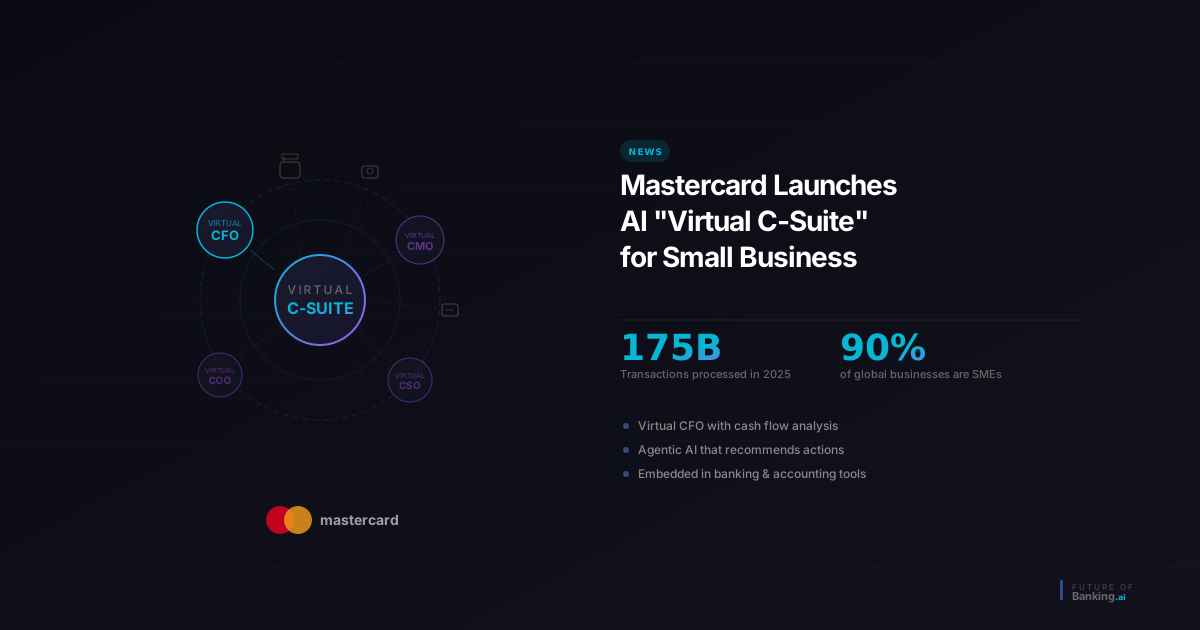
Mastercard has unveiled a new AI-powered initiative designed to bring enterprise-grade decision-making tools to small businesses. The company announced the launch of Virtual C-Suite, an agentic AI platform that provides small businesses with digital executive roles — beginning with a Virtual CFO — to help owners analyze financial performance, manage risk, and make smarter operational decisions.
The announcement marks a major step in Mastercard's broader strategy to apply AI across the entire commerce lifecycle, moving beyond insights to recommending and executing next-best business actions.
<iframe src="https://www.youtube.com/embed/tHb78C7mx0w" title="Mastercard Virtual C-Suite" allow="accelerometer; autoplay; clipboard-write; encrypted-media; gyroscope; picture-in-picture" allowfullscreen></iframe>
Bringing Enterprise-Level Intelligence to Small Businesses
Small and medium enterprises (SMEs) make up nearly 90% of businesses worldwide and account for a significant portion of global employment and economic activity. Yet many small businesses operate without specialized financial, marketing, or security teams.
Mastercard says its new AI-driven platform aims to bridge that gap.
The Virtual C-Suite acts as a team of digital executives embedded within the systems small businesses already use — including banking platforms, accounting software, and other operational tools. Each AI agent is designed to replicate the role of a senior executive, helping business owners understand their financial health and identify opportunities for growth.
The first role to be introduced will be the Virtual CFO, which will provide financial insights such as cash flow analysis, working capital recommendations, and operational forecasts.
According to the company, the platform draws on insights from Mastercard's global payments network — which processed 175 billion transactions in 2025 — combined with each business's own financial activity to generate tailored recommendations.
From Financial Insights to Recommended Actions
Unlike traditional financial dashboards that simply present data, Mastercard's Virtual C-Suite is designed to actively interpret information and guide business decisions.
Once integrated into a business's software environment, the AI continuously:
- Analyzes financial performance and spending patterns
- Identifies emerging risks or growth opportunities
- Predicts potential outcomes based on transaction trends
- Recommends operational or financial actions to improve performance
Business owners can interact with the system through conversational interfaces and dashboards, asking questions such as:
- "What caused this week's cash flow change?"
- "Which expenses increased this month?"
- "What actions should I take to improve margins?"
The system then surfaces relevant data and suggests practical next steps.
A Growing Role for Agentic AI in Commerce
The launch reflects a broader shift toward agentic AI, where AI systems do more than generate information — they actively analyze context and assist in decision-making.
Industry analysts say the development could significantly level the playing field for smaller businesses.
Christopher Miller, lead analyst of Emerging Payments at Javelin Strategy & Research, noted that enterprise-level financial intelligence has traditionally been available only to large organizations.
"Agents that offer big picture insights combined with unique and local analysis are becoming a critical human augmentation tool. Agentic AI creates the opportunity for smaller organizations to benefit from insights that were historically available only to large enterprises."
Delivered Through Banks and Business Platforms
Mastercard plans to distribute the Virtual CFO and future AI roles through partnerships with financial institutions, accounting platforms, and business software providers.
Rather than functioning as a standalone product, the AI agents will be embedded into the tools small businesses already rely on.
Additional executive roles are expected to follow the Virtual CFO launch, expanding the platform into a full AI-powered digital leadership layer supporting areas such as marketing, security, and operational management.
Mastercard's Expanding AI Strategy
The Virtual C-Suite initiative builds on Mastercard's broader push to integrate AI across its services — from fraud detection and payment security to predictive analytics and financial insights.
By combining its global payments data with AI-driven analysis, the company aims to help businesses move beyond raw financial information to actionable recommendations.
Mark Barnett, Global Head of SMEs at Mastercard, said the goal is to simplify the operational complexity faced by small businesses.
"Small businesses are the cornerstones of communities, but owners often find themselves stretched across multiple roles. With Virtual C-Suite, we are bringing the strategic expertise usually available to large enterprises directly to entrepreneurs."
The Bigger Picture: AI as the New Business Advisor
As AI continues to evolve, tools like Virtual C-Suite highlight a broader trend: intelligent systems increasingly acting as advisors rather than just software.
For many small businesses operating with limited resources, that shift could fundamentally change how decisions are made — giving entrepreneurs access to insights that were once the domain of corporate finance teams.
With its latest launch, Mastercard is positioning itself at the center of this transformation, helping small businesses turn data into actionable intelligence while continuing to build on its role in the global payments ecosystem.